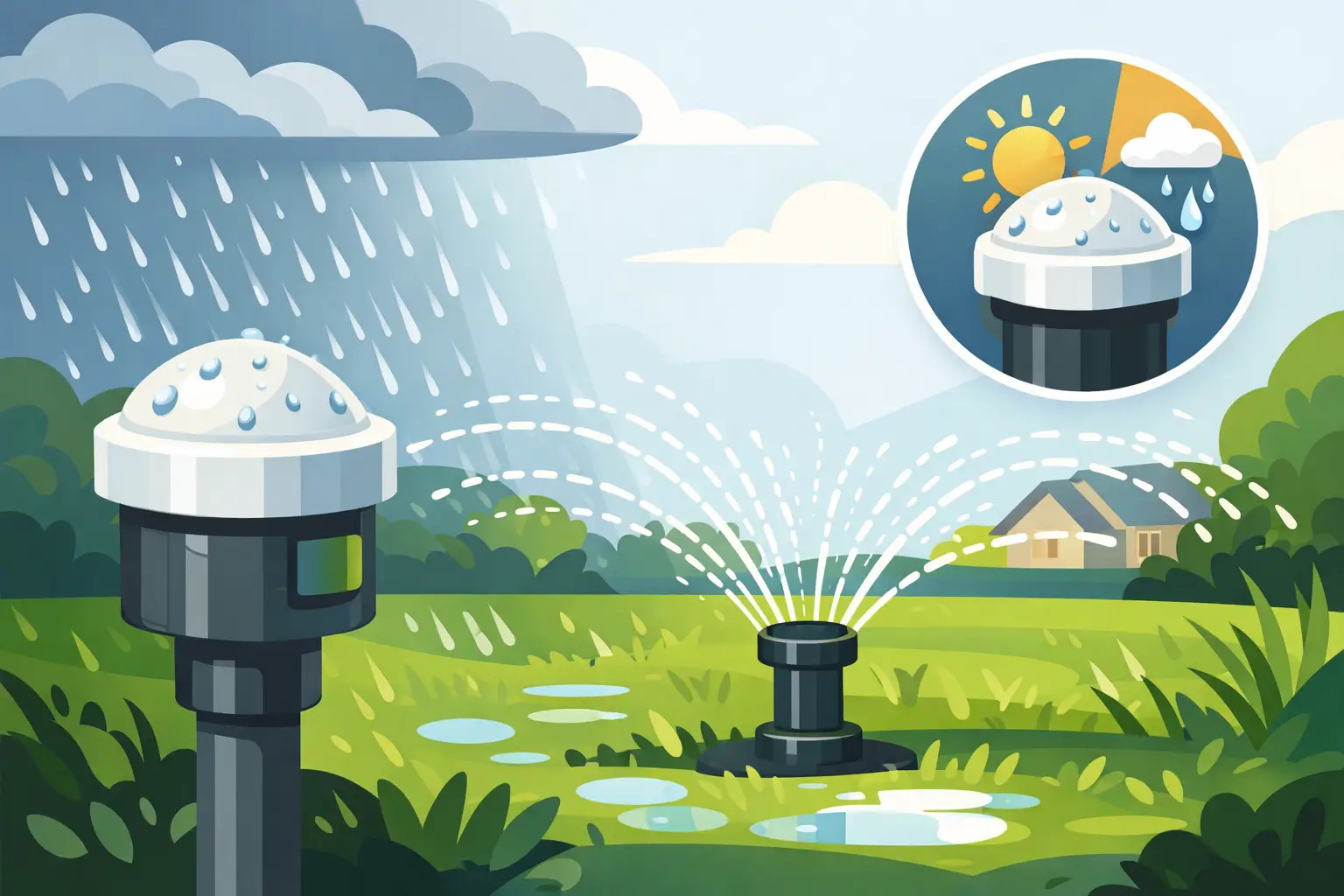
A sprinkler system running during a steady Ottawa rainfall is more than an inconvenience. It wastes water, can leave turf overly saturated, and makes a well-maintained property look neglected. This rain sensor sprinkler review looks at whether this small irrigation upgrade delivers meaningful value for homeowners who want a healthy lawn with less waste and less day-to-day effort.
For most residential systems, the answer is yes. A properly installed rain sensor is one of the simplest and most practical ways to make automatic watering more efficient. It does not replace good system design, seasonal service, or smart programming. What it does is stop your system from watering when nature has already done the job.
What a Rain Sensor Does for Your Sprinkler System
A rain sensor is mounted in an open area where it can receive rainfall, commonly on a gutter, fence, roofline, or exterior wall. When enough rain falls, the sensor interrupts the irrigation controller’s watering signal. Your scheduled program stays in place, but the system will not run until the sensor has dried and reset.
Most models use absorbent discs that expand when wet. As the discs dry, they shrink and allow irrigation to resume. The homeowner can usually set the rainfall threshold, such as one-eighth, one-quarter, or one-half inch of rain, based on lawn conditions and personal preference.
That simple function addresses a common problem with timer-based irrigation. A controller knows the day and time it has been programmed to run. On its own, it does not know whether the lawn has already received an inch of rain. A rain sensor provides that missing information.
Rain Sensor Sprinkler Review: Where It Delivers Value
The main benefit is straightforward: it prevents unnecessary watering after rain. That means less water sent into already damp soil, less runoff from hard surfaces, and fewer irrigation cycles that serve no purpose.
For busy homeowners, the convenience matters just as much. You do not have to remember to shut off the controller before a storm or turn it back on later. Once installed and set correctly, the sensor handles routine rainfall without constant attention.
It can also help protect lawn health. Overwatering does not create a better lawn. It can encourage shallow root growth, increase disease pressure, and leave areas of the yard soft or muddy. Grass needs consistent moisture, but it also needs air movement in the soil and time to dry between watering cycles. Skipping an irrigation run after adequate rainfall supports a more balanced watering routine.
There is a practical equipment benefit as well. Every skipped cycle means less run time on valves, wiring, and sprinkler heads. A rain sensor will not eliminate normal maintenance, but it prevents wear associated with needless operation.
For properties with slopes, compacted soil, or drainage concerns, the value can be even greater. Watering an already saturated lawn may lead to pooling, runoff, and uneven conditions across the property. A sensor is a low-cost safeguard against adding water when the ground cannot use it.
What a Rain Sensor Does Not Do
A rain sensor is useful, but it is not a complete smart irrigation strategy. It responds to rainfall, not to all the conditions that affect how quickly your lawn uses water.
For example, a sensor will not automatically account for high temperatures, strong wind, soil type, sun exposure, or the different needs of garden beds and turf. A hot, dry stretch after a light rain may still require an adjusted schedule. Likewise, a poorly designed system with broken heads, leaking valves, or incorrect coverage will still waste water even with a rain sensor installed.
Placement also matters. If the sensor is mounted under an eave, blocked by trees, or positioned where it receives more or less rain than the lawn, it may not respond accurately. It needs an unobstructed location that represents the rainfall your landscape receives.
The drying setting deserves attention, too. If the sensor resets too quickly, the irrigation system may run before the lawn has had time to absorb rainfall. If it stays shut off too long, sunny and well-drained areas may become dry. The right setting depends on your soil, turf, drainage, and the season.
Wired vs. Wireless Rain Sensors
Homeowners typically choose between wired and wireless rain sensors. Both can work well when matched to the controller and installed properly.
A wired sensor connects directly to the irrigation controller. It is dependable, does not require a transmitter battery, and is often a sensible option when wiring access is simple. Installation can take more effort if the sensor location is far from the controller or if existing landscaping makes cable routing difficult.
A wireless sensor uses a transmitter at the sensor location and a receiver at the controller. It is often easier to add to an established system because there is no need to run wire across the property. The trade-off is that batteries must be checked and replaced as needed, and the transmitter must remain within reliable range of the receiver.
Neither option is automatically better. For a new sprinkler installation, a wired sensor may be clean and economical to include from the start. For an older system, wireless can be a practical upgrade with less disruption. Compatibility with the existing controller should be confirmed before selecting either type.
Rain Sensor vs. Weather-Based Controller
A weather-based controller is a more advanced option. Rather than simply interrupting watering after rain, it adjusts schedules based on weather data, seasonal conditions, and estimated plant water needs. Some models use local weather information through Wi-Fi, while others use on-site sensors.
That added control can be valuable for homeowners who want more precise scheduling across changing conditions. It is especially helpful for larger properties, varied landscape zones, and homeowners who travel often. However, it comes with a higher upfront cost and may require more thoughtful setup than a standard timer.
A rain sensor remains a strong choice for many homes because it solves the most obvious waste problem at a modest cost. If your current controller is reliable and your schedule is generally well programmed, adding a rain sensor may be all that is needed to improve efficiency.
If your controller is aging, difficult to program, or unable to manage different areas of the yard effectively, a weather-based controller may be the better long-term upgrade. In some systems, a rain sensor can also work alongside a smart controller as an added layer of protection.
Installation and Seasonal Service Matter
The sensor itself is simple, but a correct installation makes the difference between a useful upgrade and one that gets ignored. The unit needs proper exposure, secure mounting, correct wiring or wireless pairing, and a functional connection to the controller.
Testing is equally important. After installation, the system should be run through a scheduled cycle while the sensor is activated to confirm that irrigation pauses as intended. The rainfall threshold and drying time should then be adjusted for the property.
Like the rest of an irrigation system, a rain sensor should be checked during seasonal service. In the spring, the sensor can be inspected for damage, cleaned, tested, and reconnected after winter conditions. During fall shutdown and winterization, the controller settings and sensor operation should be reviewed as part of protecting the entire system.
This is also a good time to look beyond the sensor. Uneven coverage, clogged nozzles, low pressure, and damaged heads can undermine the water savings a sensor provides. Efficient irrigation comes from the system working as a whole, not from one component alone.
Is a Rain Sensor Worth Adding?
For most homeowners with automatic sprinklers, a rain sensor is worth adding. It is a practical upgrade that reduces waste, avoids watering in the rain, and gives you one less task to manage during an unpredictable season.
It is particularly worthwhile if your sprinkler system runs on a fixed schedule, your property receives regular rainfall, or you have noticed the system operating when the lawn is already wet. The return is not just about water use. It is about protecting the lawn from excess moisture and keeping your irrigation system aligned with actual conditions.
There are situations where it may not be the first priority. If your system has leaks, poor coverage, a failing controller, or major zone problems, those repairs should come first. A rain sensor cannot correct underlying performance issues. Once the system is operating properly, it becomes a sensible addition that helps it run more responsibly.
At Advanced Irrigation, we see rain sensors as part of a practical approach to modernizing residential irrigation. The best setup is not necessarily the most complicated one. It is the one that delivers even coverage, responds to changing conditions, and keeps your lawn healthy without wasting water.
A well-placed rain sensor will not ask for much attention, but it can prevent plenty of unnecessary watering. For homeowners who value a greener lawn and a more reliable system, that is a small upgrade with a clear purpose.