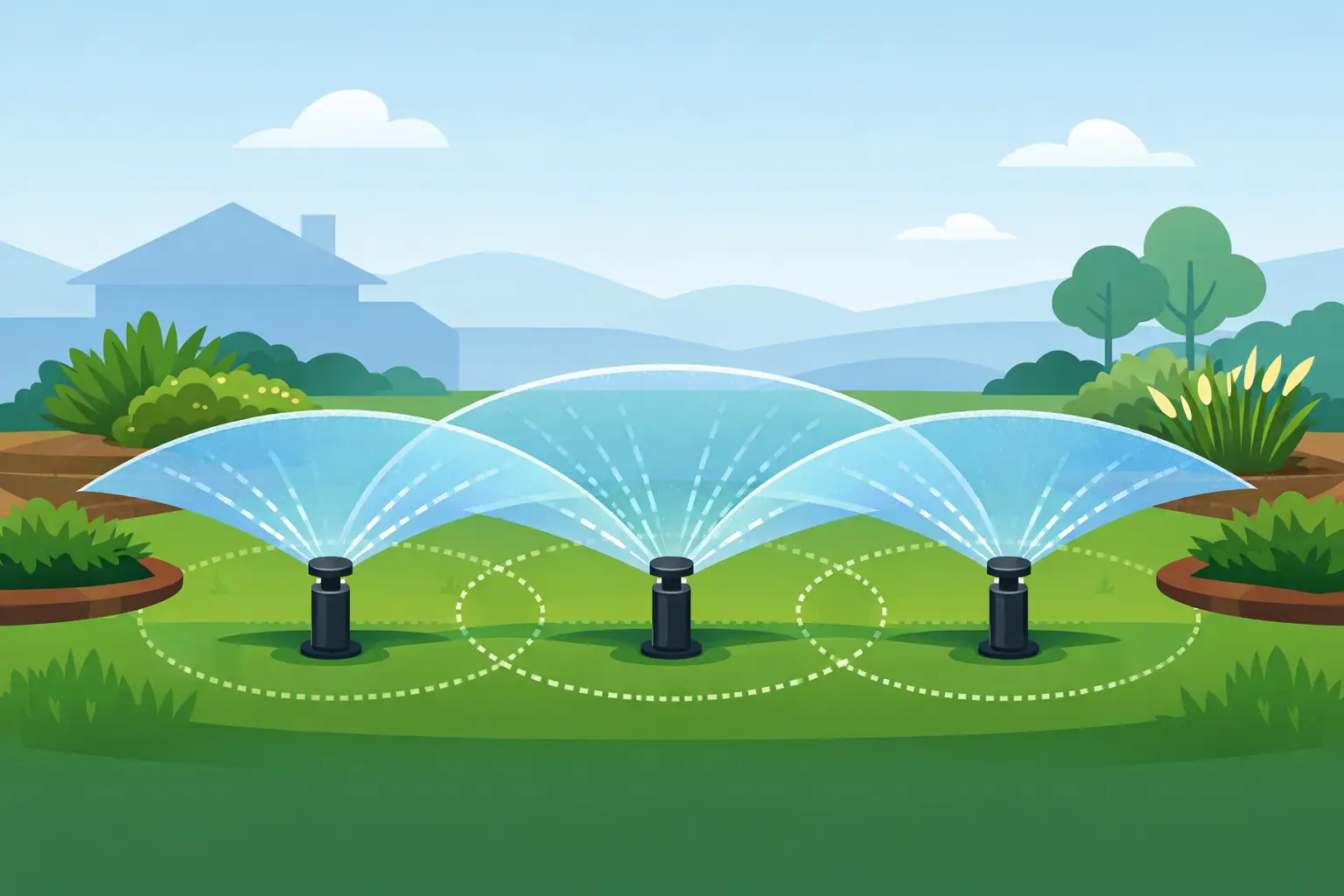
A lawn can look green near the sprinkler heads and still be thirsty between them. That is the usual sign of poor layout, not a lack of watering time. This sprinkler head spacing guide explains how professional spacing creates even coverage, protects your landscape, and helps prevent water from being wasted on sidewalks, driveways, and oversaturated soil.
For homeowners, the goal is simple: every part of the lawn should receive the right amount of water at the right rate. Getting there requires more than placing heads a few feet apart and hoping for the best. Sprinkler type, water pressure, lawn shape, slopes, and plant material all affect the design.
Why Sprinkler Head Spacing Matters
Sprinkler spray does not fall evenly from the center of the pattern to its outer edge. Most heads deliver less water at the farthest reach of their spray. If heads are spaced too far apart, the areas between them receive less water, creating dry strips, weak turf, and uneven color.
Professional layouts use head-to-head coverage. In practical terms, the spray from one sprinkler should reach the next sprinkler head. That overlap helps compensate for lighter watering at the edge of each spray pattern and gives the lawn a more consistent application rate.
Spacing heads too closely can be just as inefficient. Excess overlap may lead to runoff, soggy patches, shallow roots, and unnecessary water use. The right layout balances coverage with the actual operating conditions on your property.
The Basic Rule: Head-to-Head Coverage
Head-to-head coverage is the starting point for nearly every residential lawn zone. If a rotor is rated to throw water 25 feet under the system’s working pressure, the next rotor should generally be placed about 25 feet away. If a spray head reaches 12 feet, the next compatible spray head should typically be no more than 12 feet away.
That rule is not a shortcut for choosing equipment. A nozzle’s published radius is based on specific pressure conditions, and real-world performance can change when several heads run at once. Low pressure reduces throw distance and produces poor distribution. Excess pressure can create mist, which is easily carried by wind and does little good for the lawn.
A properly designed system accounts for pressure and flow before the installation begins. It also divides the property into zones so each zone can operate within the available water supply.
Sprinkler Head Spacing Guide by Head Type
Different heads water at different rates and cover different shapes. Mixing them without careful design is a common reason lawns develop dry areas and overly wet areas at the same time.
Fixed Spray Heads
Fixed spray heads are often used for smaller turf areas, narrow side yards, and landscape beds. They typically cover distances from roughly 5 to 15 feet, depending on the nozzle. Their spacing should match the actual nozzle radius, with head-to-head coverage throughout the zone.
These heads apply water relatively quickly. They are useful where short run times make sense, but they should not share a zone with rotors. A spray head and a rotor may cover similar-looking lawn areas, yet their precipitation rates are very different. Running them together often means one area gets too much water while another gets too little.
Rotor Heads
Rotors are suited to larger, open lawn areas and usually have an adjustable radius. Typical residential rotor spacing can range from about 18 to 35 feet, depending on the nozzle, pressure, and model.
Because rotors apply water more slowly than spray heads, they are a good fit for larger areas and can be especially helpful on soils that absorb water slowly. They still need correct overlap. A rotor set to reach 30 feet should not be installed 35 or 40 feet from the next head simply to reduce the head count. The result is usually a dry section that becomes obvious during hot weather.
Multi-Stream Rotary Nozzles
Multi-stream rotary nozzles fit many spray-head bodies but apply water in several rotating streams at a slower rate than traditional fixed sprays. They can work well on slopes, oddly shaped spaces, and clay-heavy soil where runoff is a concern.
Spacing depends on the nozzle’s rated radius, often between 8 and 20 feet. As with other equipment, match the head spacing to the rated throw and keep the nozzles on a separate zone from conventional spray heads unless the application rates are designed to match.
Shape the Layout Around the Lawn
Most lawns are not perfect rectangles, which is why a simple grid does not always work. The layout needs to match corners, curves, narrow strips, patios, driveways, and garden beds.
Start with corner heads. A corner generally needs a quarter-circle pattern, while an outside edge may use a half-circle pattern. Full-circle heads belong in open interior areas. Each pattern needs to reach the neighboring head, not merely spray in its general direction.
Narrow side yards require particular attention. Installing standard heads along both sides may create excessive overlap, while heads placed only on one side may not reach the far edge reliably. The best solution may be a smaller-radius nozzle, a strip-pattern nozzle, or multi-stream rotary nozzles selected for the exact width of the space.
Avoid placing sprinkler heads where vehicles, foot traffic, or lawn equipment will constantly strike them. Heads should sit at grade when retracted and rise high enough to clear the turf during operation. A head tilted by soil movement or damaged by a mower can throw water well beyond its intended radius.
Pressure, Wind, and Slopes Change the Plan
A spacing chart is useful, but it cannot replace a site assessment. Ottawa-area properties deal with changing weather, clay soils in many neighborhoods, mature trees, and grades that can vary sharply from the front lawn to the backyard.
Wind can distort fine spray, especially with high-pressure fixed spray heads. On exposed properties, closer spacing or equipment that produces larger water droplets may be needed. Watering in the early morning also reduces evaporation and wind interference.
Sloped lawns need controlled application rates. When water is applied faster than the soil can absorb it, it runs downhill instead of reaching the roots. In those areas, slower-application nozzles and cycle-and-soak programming can make a major difference. The controller runs shorter cycles with time between them, allowing water to soak in before the next cycle begins.
Trees also affect spacing. Their canopies can block spray, while their roots compete with grass for moisture. Rather than increasing runtime for an entire zone, it is often better to adjust the layout or add targeted coverage where the lawn is being shaded or intercepted.
Common Spacing Mistakes That Waste Water
The most common mistake is spacing heads based on visual convenience rather than measured radius. A head may appear to reach the next section of grass, but a coverage test will often show that the far edge receives much less water.
Other frequent problems include mixing rotors and spray heads on the same zone, using the wrong nozzle for a narrow area, installing heads too close to hard surfaces, and ignoring pressure loss from undersized piping or too many heads operating at once. These issues can lead to brown spots, runoff, and higher water use even when the controller is set correctly.
A quick inspection can reveal a lot. Run each zone and watch for gaps between spray patterns, misting, water hitting pavement, heads that do not pop up fully, and streams blocked by grass or shrubs. Cleaning or adjusting a single nozzle can help, but recurring uneven coverage usually points to a design or pressure issue.
When Professional Design Is Worth It
A new system, a major landscape renovation, or an aging system with repeated dry spots deserves more than trial-and-error adjustments. A professional design considers available flow, operating pressure, pipe sizing, zone capacity, soil conditions, and the exact radius of each nozzle before installation.
Advanced Irrigation designs residential systems around the property rather than forcing a standard layout onto every lawn. That approach helps deliver consistent coverage while supporting smart controllers, seasonal maintenance, repairs, and future upgrades.
The right spacing is rarely the widest distance a sprinkler can possibly throw. It is the distance that gives every section of your lawn dependable coverage under real operating conditions. When the system is designed with that standard in mind, a healthier lawn takes less effort to maintain.