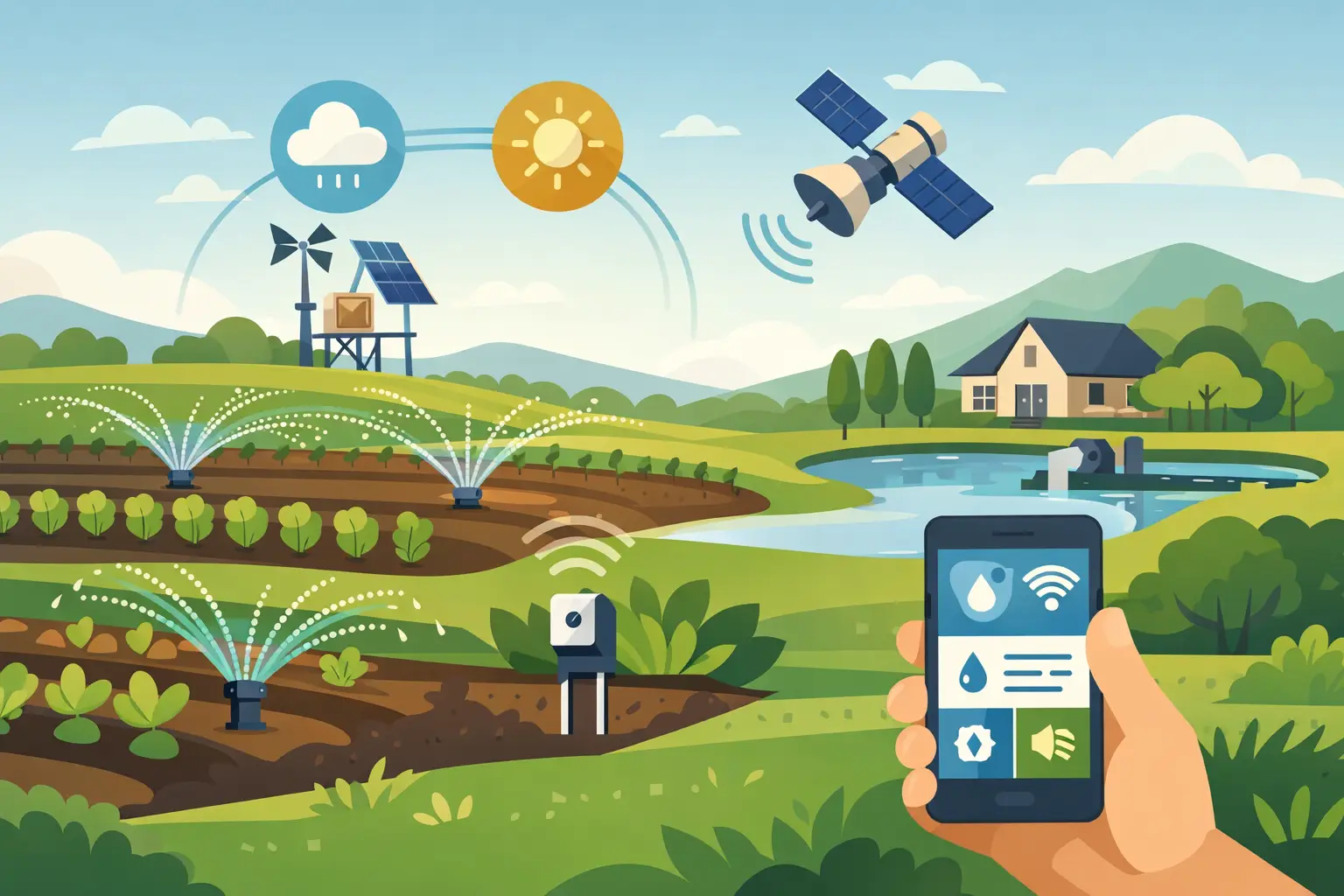
If you have ever watched your sprinklers run in the rain, you have already seen why homeowners ask, how does smart irrigation work? A smart system is built to stop that kind of waste. Instead of running on a fixed timer alone, it uses weather data, site conditions, and system programming to water your lawn only when it actually needs it.
For Ottawa homeowners, that matters. Our weather can swing from heavy spring moisture to dry summer heat, and a basic controller does not adjust on its own. Smart irrigation helps protect your lawn from overwatering, underwatering, and the uneven results that often come from outdated sprinkler setups.
How does smart irrigation work in a real yard?
At the center of a smart irrigation system is the controller. You can think of it as the brain of the system. A standard controller follows a schedule you set manually. A smart controller still uses scheduled zones, but it also reacts to outside information before deciding whether to water, how long to run, and when to hold back.
That outside information usually comes from local weather data, on-site sensors, or both. If rain is expected, the system can delay watering. If temperatures rise and the soil dries out faster than normal, it can increase runtime within the programmed limits. If the ground is already holding enough moisture, it can skip a cycle altogether.
The sprinkler hardware still does the physical work. Heads pop up, rotors turn, and valves open by zone just like they would in a conventional irrigation system. The difference is in the decision-making. Smart irrigation adds a layer of control that makes the whole system more precise.
The main parts of a smart irrigation system
Most residential smart irrigation systems rely on a few core components working together. The controller manages timing and zone operation. Valves direct water to each section of the property. Sprinkler heads apply water based on the layout and coverage needs of the lawn, gardens, or planting beds.
Then there are the smart features. A rain sensor is one of the simplest and most effective upgrades. When enough rain has fallen, it interrupts watering so the system does not run unnecessarily. More advanced setups may include soil moisture sensors, which measure how much water is actually present in the root zone. Some controllers also use live weather data, including rainfall, temperature, humidity, and seasonal evapotranspiration rates, to fine-tune scheduling.
A mobile app often ties everything together for the homeowner. That gives you basic visibility and control without having to stand at the controller in the garage. You can pause watering, adjust schedules, or check system activity from your phone. That convenience is useful, but the bigger value is that the system is making better watering decisions in the background.
Why weather-based watering saves water
The biggest problem with old-school irrigation is that it treats every week the same. In reality, your lawn’s water demand changes constantly. A cool week in June is not the same as a hot, windy week in July. A shaded side yard does not dry out at the same rate as a front lawn in full sun.
Smart irrigation accounts for those changes. Weather-based controllers estimate how much moisture your lawn is losing and replace only what is needed. That is where real water savings come from. You are not just shutting the system off when it rains. You are reducing unnecessary watering throughout the season.
That said, smart technology is not magic. If the system was poorly designed to begin with, a new controller alone will not fix every issue. Misaligned heads, poor pressure, clogged nozzles, and bad zone layout can still create dry spots or runoff. The best results come when smart controls are paired with a properly designed and maintained sprinkler system.
Smart irrigation still depends on good system design
This is where many homeowners get disappointed. They hear “smart irrigation” and assume any app-enabled controller will solve lawn problems overnight. It usually does not work that way.
A smart controller can only manage the system it is connected to. If one zone has too many heads, if another sprays the sidewalk, or if coverage overlaps badly, the system will still waste water. It may waste less than before, but it will not perform at its best.
Good irrigation starts with the basics: correct head spacing, matched precipitation rates, reliable valves, proper pressure, and zoning that reflects the conditions on the property. Sunny turf areas should not always be watered the same as shaded areas. Sloped sections may need shorter cycle times to prevent runoff. Garden beds and lawns often need different scheduling altogether.
That is why upgrades work best when they are approached as a complete system, not just a gadget swap. In many cases, a homeowner can modernize an existing setup rather than replacing everything. In other cases, especially with aging infrastructure, a more thorough redesign makes more sense long term.
What smart irrigation changes for the homeowner
The biggest benefit is consistency. Lawns do better when they receive the right amount of water at the right time. Too little water causes stress, thinning, and brown patches. Too much water can encourage shallow roots, disease pressure, and waste.
Smart irrigation helps narrow that margin of error. You spend less time guessing, less time adjusting timers after every weather change, and less time dragging hoses around to compensate for poor coverage. For busy homeowners, that is a real quality-of-life improvement.
There is also a cost side to consider. Lower water use can reduce utility costs, especially during high-demand summer months. The savings vary based on property size, weather, and how inefficient the old schedule was, so there is no honest one-size-fits-all number. Still, when a system avoids unnecessary watering week after week, those reductions add up.
Common smart irrigation upgrades
For some homes, the right move is a new installation designed around smart control from day one. For others, it is an upgrade path. A common first step is replacing an older timer with a smart controller. Adding a rain sensor is another practical improvement if one is not already in place.
If the system has aging heads, leaking valves, wiring issues, or poor coverage, those should be addressed at the same time. There is little value in giving a smarter brain to a system with mechanical problems. Homeowners often get better long-term performance by combining controller upgrades with repairs, nozzle changes, and zone adjustments.
Seasonal service matters too. Even the best smart irrigation system needs spring startup, mid-season checks when needed, and proper winterization in a climate like Ottawa’s. Freeze damage, broken heads, and unnoticed leaks can undo the efficiency gains quickly if the system is not maintained.
Is smart irrigation worth it?
For many homeowners, yes – especially if convenience, curb appeal, and water efficiency all matter. A smart system reduces manual effort and improves the odds that your lawn gets consistent care even when weather changes fast. It is particularly useful for people who travel, have busy schedules, or simply do not want to keep adjusting a controller all summer.
But it is not a blanket answer for every property. If a lawn has drainage issues, poor soil, heavy shade, or serious wear from pets and foot traffic, irrigation is only one part of the picture. Smart watering helps, but it works best as part of an overall lawn care plan.
Homeowners also need realistic expectations. A smart system can improve efficiency and make maintenance easier, but it still needs professional setup and occasional service. The value is in getting a system that is properly designed, programmed, and supported over time. That is where experience matters.
For a company like Advanced Irrigation, the goal is not just to install sprinklers. It is to give homeowners a reliable system that waters accurately, saves water where possible, and holds up season after season.
If you are considering smart irrigation for your home, the right question is not only how the technology works. It is whether your current system, property layout, and lawn needs are being matched with the right solution. When that fit is right, smart irrigation stops feeling like a feature and starts feeling like one less thing you have to worry about.